
Product number:
940141624050300
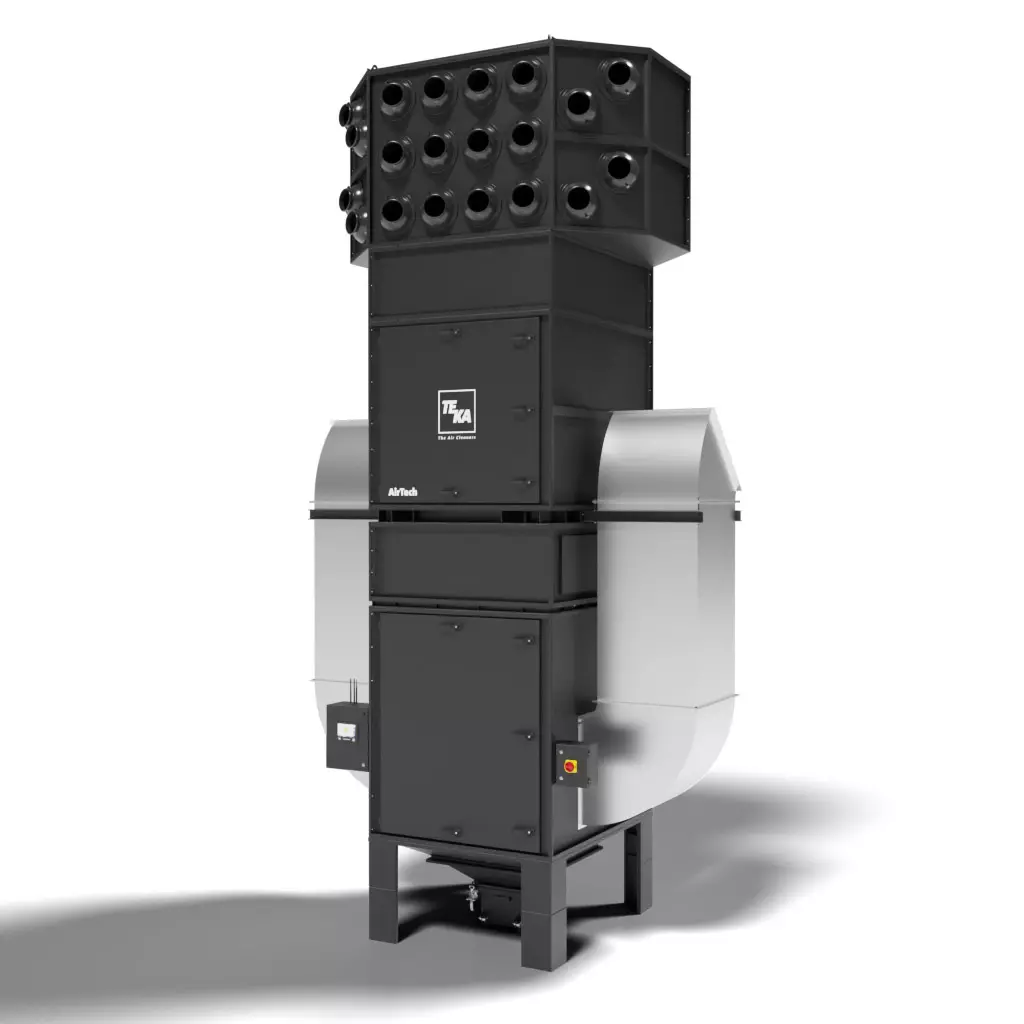
TEKA AirTech P24 (EC Generation)
Delivery time on request
You will see your price after login
TEKA AirTech P24 (EC Generation)
Protective measures / Principle
If exposure of employees to hazardous substances cannot be avoided during welding work, suitable protective measures are required to eliminate or minimise the resulting risk. In accordance with the Hazardous Substances Ordinance, the following measures must be taken into account in the order listed below, depending on the specific circumstances of the workplace.
• Selection of processes and filler materials with low levels of hazardous substances (assessment of substitution options; see TRGS 528, section 4.2)
•Ventilation measures (see TRGS 528, sections 4.3 to 4.5)
• Organisational and hygiene measures (see TRGS 528, section 4.6)
•Personal protective measures (see TRGS 528, section 4.7)
How does the AirTech system work?
The air containing pollutants is drawn in via the side-mounted intake ducts, whose intake point is situated at a height of approximately 4 metres, and is directed into the filter section. Here, the particulate pollutants are deposited on the surface of the filter cartridges. The filter cartridges are cleaned fully automatically at the required intervals using compressed air. The system should be switched to offline mode several times a day to maintain post-cleaning and to ensure a consistently good operating status. The particles adhering to the cartridges are dislodged by the blast of compressed air and enter a dust collection container. The cleaned air is returned to the work area via individually adjustable long-throw nozzles. This also directs the air containing pollutants towards the intake ducts. As a safety feature, the system is equipped with a particle sensor on the clean air side. This enables continuous safety monitoring of the system, for example to detect filter breaches. If a fault is detected, the fan switches off automatically. At the same time, the system control unit emits a visual and audible signal to warn the user.
Is the AirTech system certified?
The AirTech series is certified in accordance with DIN EN ISO 21904-1/-2 and has been tested for hazardous substances by the IFA (Institute for Occupational Safety and Health of the German Social Accident Insurance – formerly BGIA) and approved as a stationary welding fume extraction unit for welding fume class W3.
What else should be taken into account?
Ventilation measures are appropriate if they minimise the risk to employees from hazardous substances. (Source: TRGS 528, 4.3)
Systems designed to extract welding fumes do not exempt the system operator from the obligation to provide appropriate local exhaust ventilation at individual workstations and personal protective equipment for their employees. When working with stainless steels, capture elements must be used. The definition of personal protective equipment is set out in TRGS 528. The measures regulated in TRGS 528 relate in particular to respiratory protection and compliance with occupational exposure limits (OELs). Personal protective measures are regulated in particular in Section 4.7 of TRGS 528.
It is important to note that, in order to comply with occupational exposure limits (AGW), the employer must provide personal protective measures – ranging from the room ventilation system offered here to individual workstation extraction – in addition to this system.
Many types of dust, including, for example, welding fume particles, are flammable in the presence of ignition sources. The user must take appropriate measures to avoid these specific hazards.
Properties
| Engine control system design: | at the plant, at operating height |
|---|---|
| Filter control structure: | at the machine, at operating height |
| medium to be filtered: | grease-free or oil-free dust / fumes |
| Volumetric flow (m³/h): | 24,000 |
| max. pressure (Pa): | 2,600 |
| Engine power (kW): | 15 |
| Supply voltage (V): | 400 |
| Connection frequency (Hz): | 50 |
| Current consumption (A): | 30 |
| Current type: | 3Ph+N+PE |
| Filter control: | Automatic filter cleaning with TouchControl Evolution |
| Engine control: | Variable-speed EC motor technology |
| main filter: | filter cartridge |
| Cartridges number: | 9 |
| Filter surface (m²): | 36 |
| Separation efficiency (%): | > 99 |
| Ausblas: | on long-range nozzles |
| Sound level (dB(A)): | 72 – in accordance with DIN EN ISO 3744 |
| Weight (kg): | 2,250 |
| Width (mm): | 3,510 |
| Depth (mm): | 1,880 |
| Height (mm): | 6,810 |
| Colour: | RAL 7016 |
Replacement parts

Filter cartridge, filter area 36 m²
size: 327 x 1715 mm, Degree of separation: BIA M
size: 327 x 1715 mm, Degree of separation: BIA M
Your price after login
Questions about this product?
Just drop us a line about what you need – we'll get back to you and figure out together what fits your application.